
Lab Team
No regulator has approved an administration schedule for retatrutide and phase 3 is incomplete. Here is what the trial literature does describe, and where we stop.
This is the one question on this site we will not answer in the form it is asked, and it seems fairer to say so in the first paragraph than to lead you through several hundred words before admitting it. We will not publish an administration schedule for retatrutide. What follows is why, what the published literature does describe, and what we think is genuinely worth your attention instead.

Why not simply answer it?
Three reasons, and none of them is caution for its own sake.
Retatrutide holds no marketing authorisation in any territory. Schedules for licensed medicines are established through regulatory assessment and appear in an approved summary of product characteristics. No such document exists here, because no regulator has assessed the compound. There is no approved schedule to report.
Phase 3 is incomplete. The trials that would establish long-term parameters are still running, and the questions they exist to answer are open. Publishing a schedule now would be reporting a conclusion from studies that have not concluded.
And material sold for laboratory research is not supplied for human use. Publishing an administration schedule alongside it would contradict that in the same breath, whatever disclaimer sat beneath it.
It is worth naming what would change this, so the refusal reads as a position rather than a hedge. If the phase 3 programme completes, a regulator assesses it, and an authorisation is granted with an approved summary of product characteristics, then a schedule will exist as a published fact with an authority behind it — and reporting a published fact is a different act from inventing one. Until that document exists there is nothing to report, and no amount of confidence on our part would create it.
What does the trial literature actually describe?
Facts about study design, which are a different category from instructions.
Retatrutide's clinical trials used a weekly administration interval. This follows from the molecule's half-life, which is long enough to support that spacing, and it is consistent with other compounds in the incretin class. This is a published characteristic of how the studies were conducted.
Those trials also escalated amounts in steps over the course of the study rather than beginning at the target level, with the escalation defined by protocol. The phase 2 trial reported that gastrointestinal adverse events were most pronounced during these escalation periods rather than at steady state, which is why the design used them.
Both of those statements describe what investigators did under medical supervision in a regulated trial. Neither is guidance, and the distinction is not a technicality. A trial protocol is a description of one controlled study, not a general instruction, and no published data extends it into one.

What does the trial interval indicate about the molecule?
That retatrutide was engineered to persist in circulation. The spacing used in the studies is a consequence of the molecule's structure rather than a preference applied on top of it, and the structure is a legitimate thing to describe.
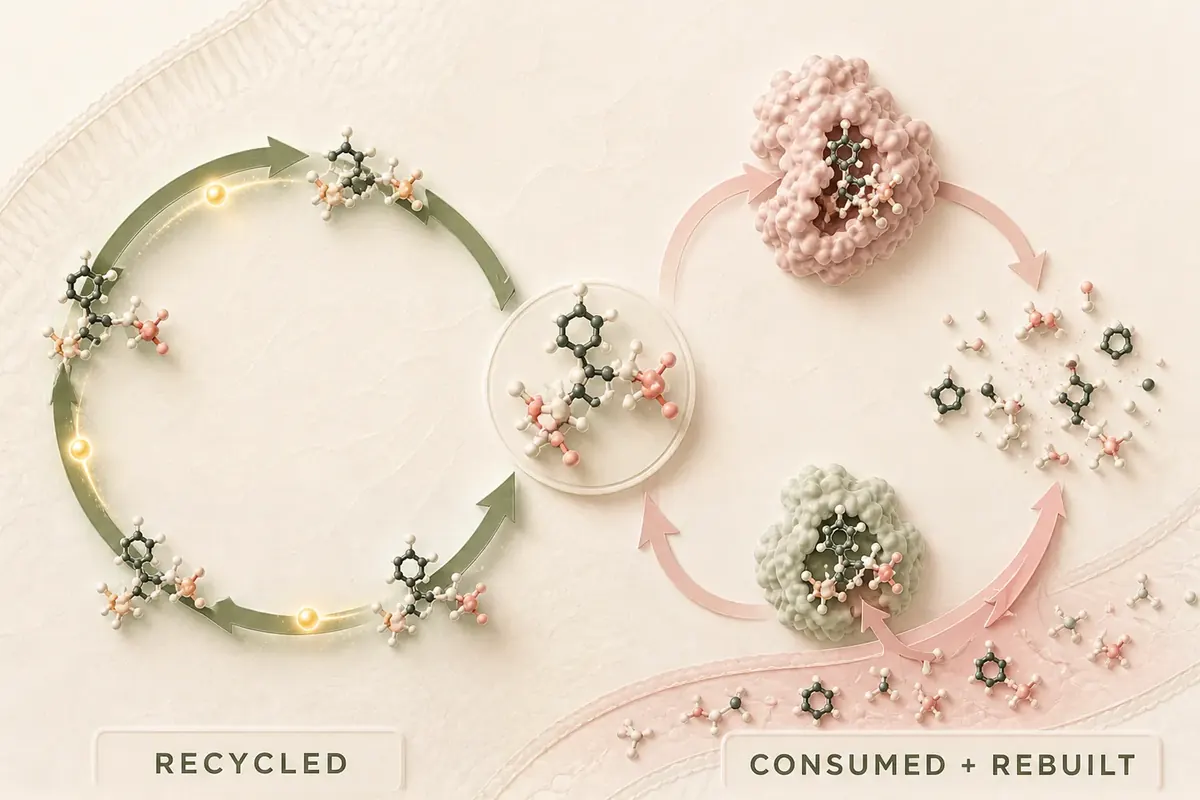
Native peptide hormones are cleared quickly, often within minutes. Any peptide intended to remain active across days has to be modified to resist that clearance, and the standard approach in this class is to attach a fatty-acid chain to the peptide backbone. That chain allows the molecule to bind reversibly to serum albumin, which circulates for far longer than a free peptide would. The bound fraction acts as a slow-releasing reservoir, and the result is a compound whose presence is measured in days rather than hours. Retatrutide carries a modification of this kind, which is why its trial protocols were able to use the spacing they did.
For anyone buying material, that structural fact has a consequence worth more than the interval itself. The modification is part of the molecule, not an additive. A material lacking it, or carrying a different one, is a different compound that will behave differently regardless of what the label says — and this is exactly the kind of difference a purity figure cannot detect, because such a material can be entirely pure and entirely wrong. It changes the molecular mass, which is precisely what mass-spectrometry identity confirmation measures.

Why is a confident answer elsewhere a warning sign?
Because the information does not exist to support it.
If no regulator has approved a schedule and phase 3 has not reported, then any source stating one with confidence has either invented it or copied someone who did. The confidence is not evidence of access to better information. It is usually evidence of not having checked.
This matters commercially, and we would rather be plain about that than pretend otherwise. A supplier willing to publish a protocol they cannot source is demonstrating their standard of evidence, and that standard applies to their certificates of analysis as much as to their guidance. What a seller is willing to state without support tells you how to read everything else they state.
There is a simple test that does not require knowing anything about the compound. Ask where the figure came from. A schedule taken from an approved product would have a summary of product characteristics behind it; one taken from a trial would have a paper behind it, along with the acknowledgement that a trial protocol is not a general instruction. A source that can produce neither is quoting itself, and the answer to that question is available before you have to evaluate a single analytical document.

Which variables are worth checking instead of the interval?
The variables that are both knowable and within your control.
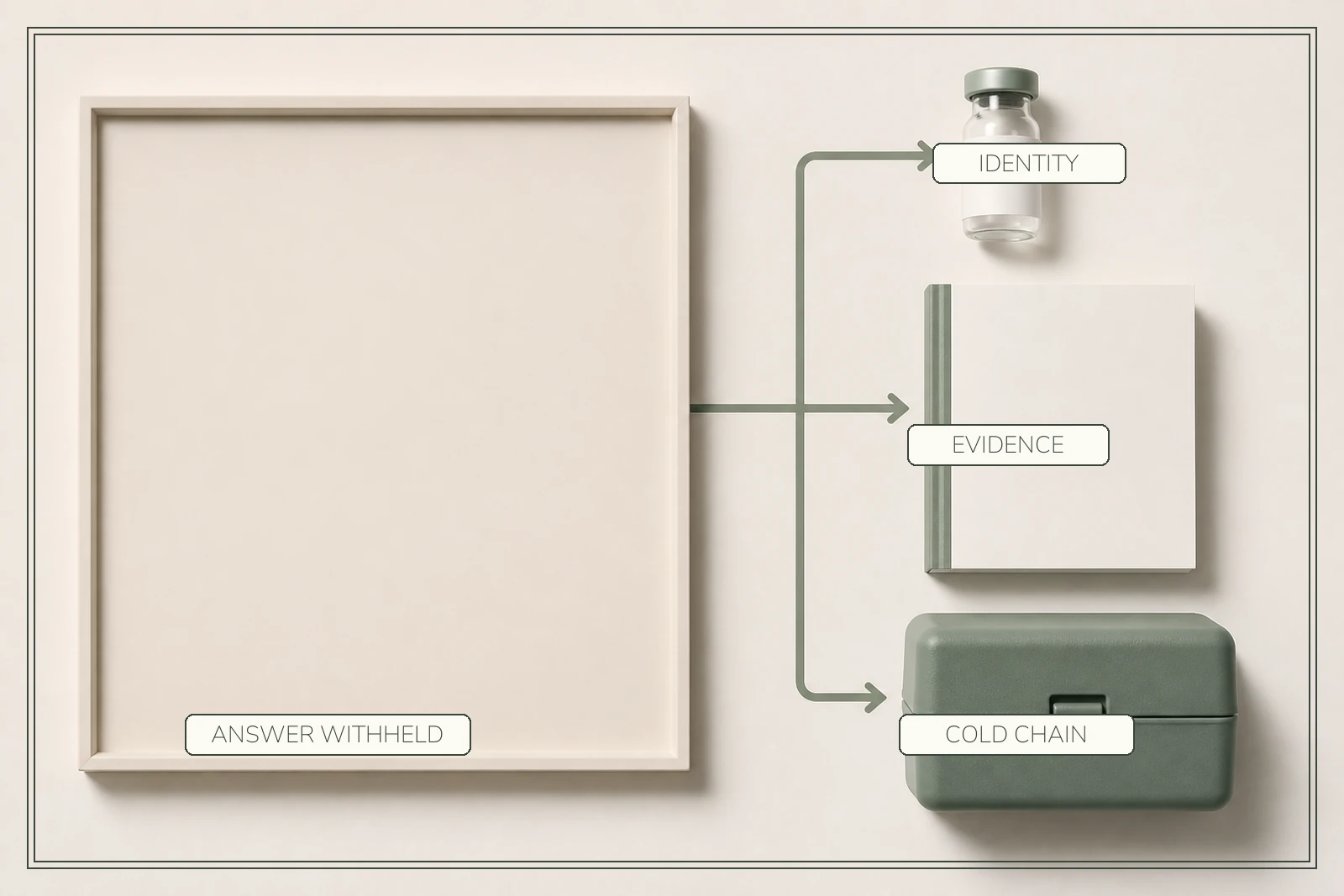
Whether the material is the correct molecule, confirmed by mass spectrometry rather than asserted on a label. Whether it is pure, evidenced by a chromatogram rather than a printed percentage. Whether it arrived intact, which depends on cold-chain handling in transit. Whether it was reconstituted without denaturation, which depends on diluent choice and on swirling rather than shaking. Whether cold-chain was maintained after delivery, and how many freeze-thaw cycles the vial has been through since.
Every one of those is determinable, every one materially affects what is actually in the vial, and none of them requires anybody to invent a figure. They are also, unlike scheduling, questions a supplier can legitimately help with.
None of that is offered as a consolation prize for the question we declined. At this stage of a compound's life the material variables genuinely dominate: the published evidence is fixed and identical for everyone reading it, so the only thing that differs between one piece of work and another is what was actually in the vial and what happened to it. They are also the cheapest variables in the whole picture to control, which is an unusual combination — high influence on the result, low cost to get right, and almost entirely determined by decisions taken before anything is opened.

What should a research plan specify instead?
The facts that decide whether a result can be interpreted once it exists — and all of them are recorded before the work rather than reconstructed after it.
The lot number, and the certificate of analysis that belongs to it. This is the single entry that connects everything downstream to a specific manufacturing event rather than to a product name.
The reconstitution details: the date, the diluent used and its own lot, and the volume added. Concentration is a derived figure, and derived figures are only as recoverable as the inputs somebody wrote down. A solution whose volume was not recorded has a concentration that can be estimated and not stated.
The storage conditions and the freeze-thaw count, tallied as the cycles happen rather than remembered afterwards. Cumulative damage is only visible if somebody was counting.
And what changed between runs — above all whether the lot changed, since a lot change mid-way through a series is the confound most likely to be mistaken for a finding.
None of that requires anybody to invent a number. Every entry is a fact about material that already exists and can simply be read off a vial, a certificate or a calendar. That is the substitution this article is offering. The scheduling question cannot be answered honestly by anyone right now. This one can be answered completely, before the work starts, and it is the one that determines whether whatever you observe afterwards can be attributed to anything at all.

What we can help with
We publish per-lot certificates of analysis whose lot numbers match the vial, HPLC chromatograms rather than summary percentages, and mass-spectrometry identity confirmation, and we ship under stated cold-chain conditions. Those are the questions we can answer with evidence, so those are the ones we answer.
We are aware this page costs us traffic that a published schedule would capture, and that a competitor two search results away is capturing it. That is the trade, and we would rather make it visibly than quietly. A supplier whose entire proposition is that its documents can be checked cannot also be the supplier that publishes a figure nobody can check.
You can see our retatrutide 20mg listing with the current lot documentation linked from it. For handling, reconstitution and storage technique covers the chemistry in full, and the supplier checklist sets out what to require from anyone. Supplied for laboratory research use only.
For research use only — not for human consumption. Nothing here is medical advice.