Lab Team
Retatrutide is a single synthetic peptide, not a blend. Here is what the nickname means, what separates it from earlier compounds, and why it has no brand name.
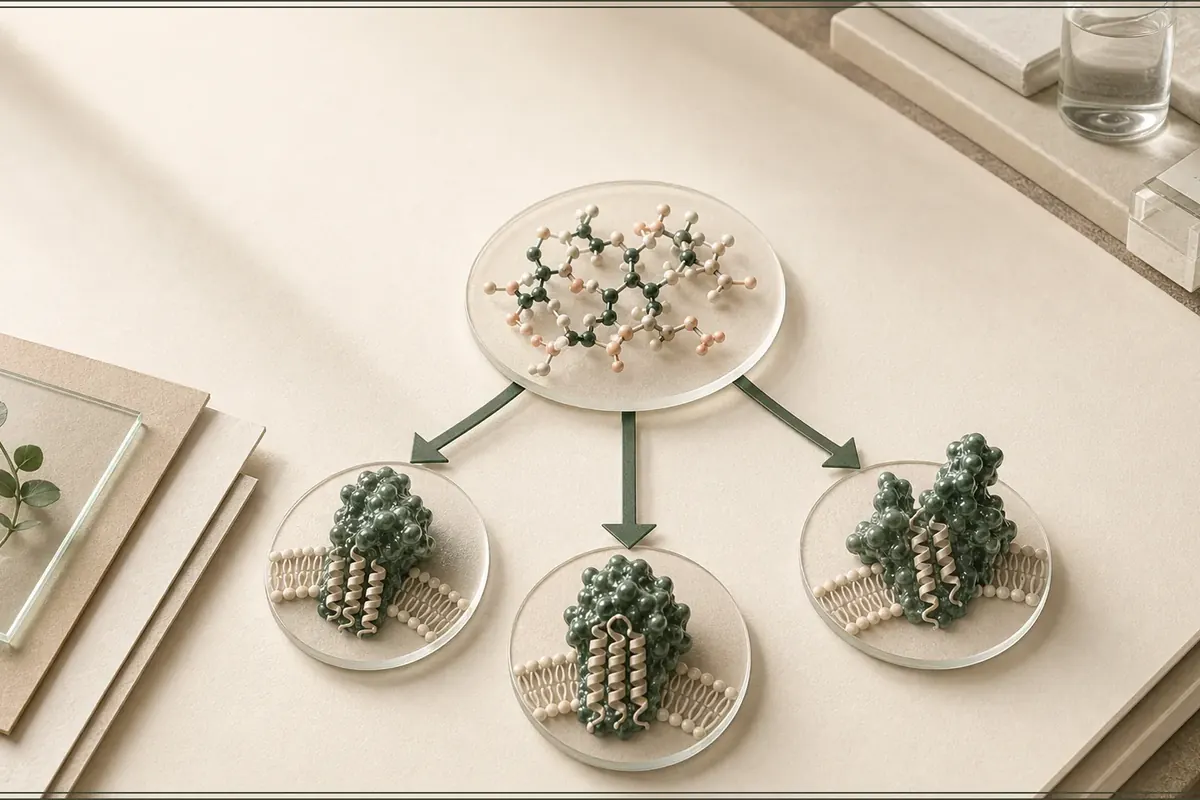
Retatrutide is a single synthetic peptide, not a blend or a stack of separate ingredients. That is worth stating first, because the question of what is *in* retatrutide is usually asked by someone who suspects they may be buying a mixture. They are not. Retatrutide, development code LY3437943, is one engineered molecule developed by Eli Lilly, and the interesting part is what that single molecule does at three different receptors.
What does the nickname Triple G refer to?
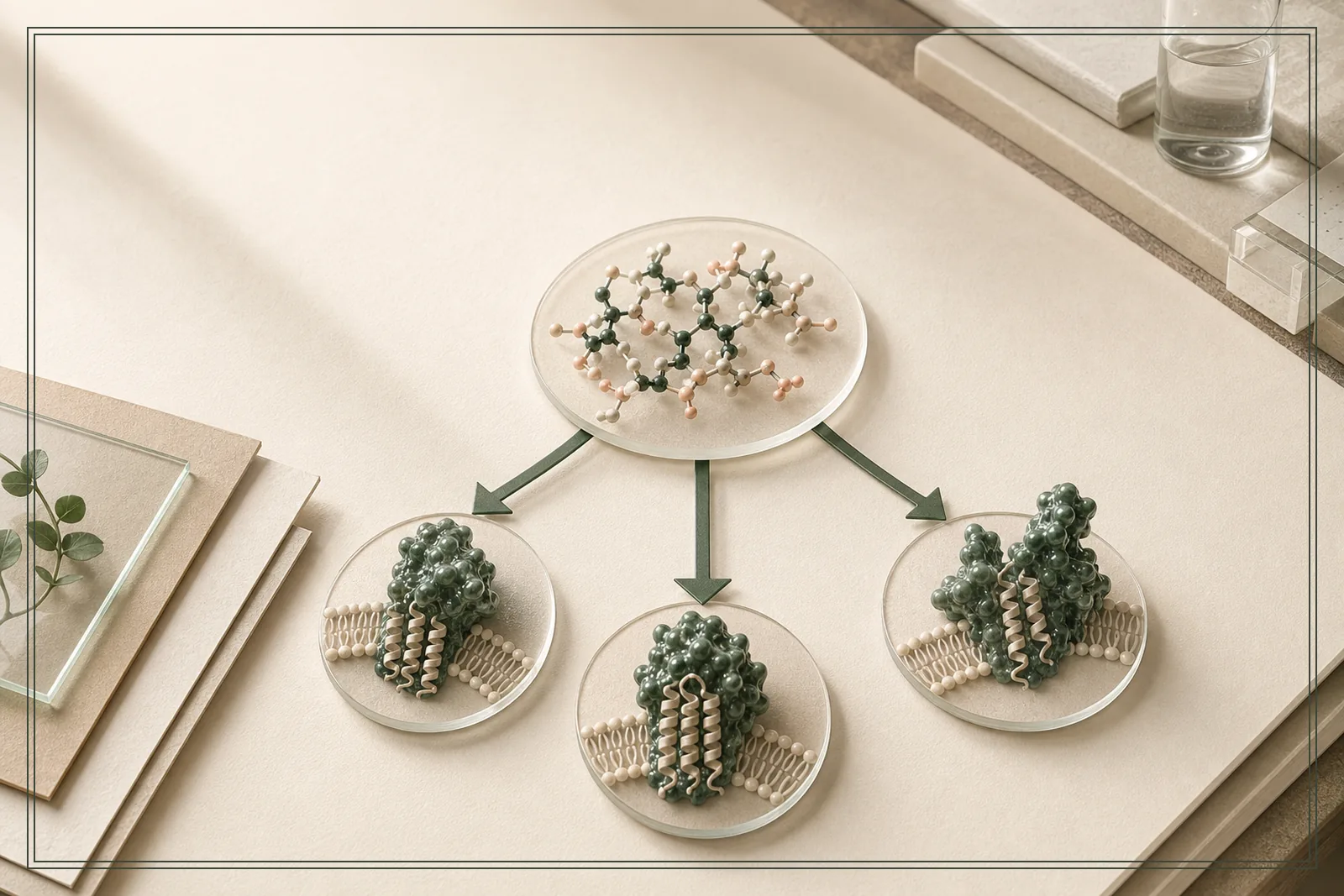
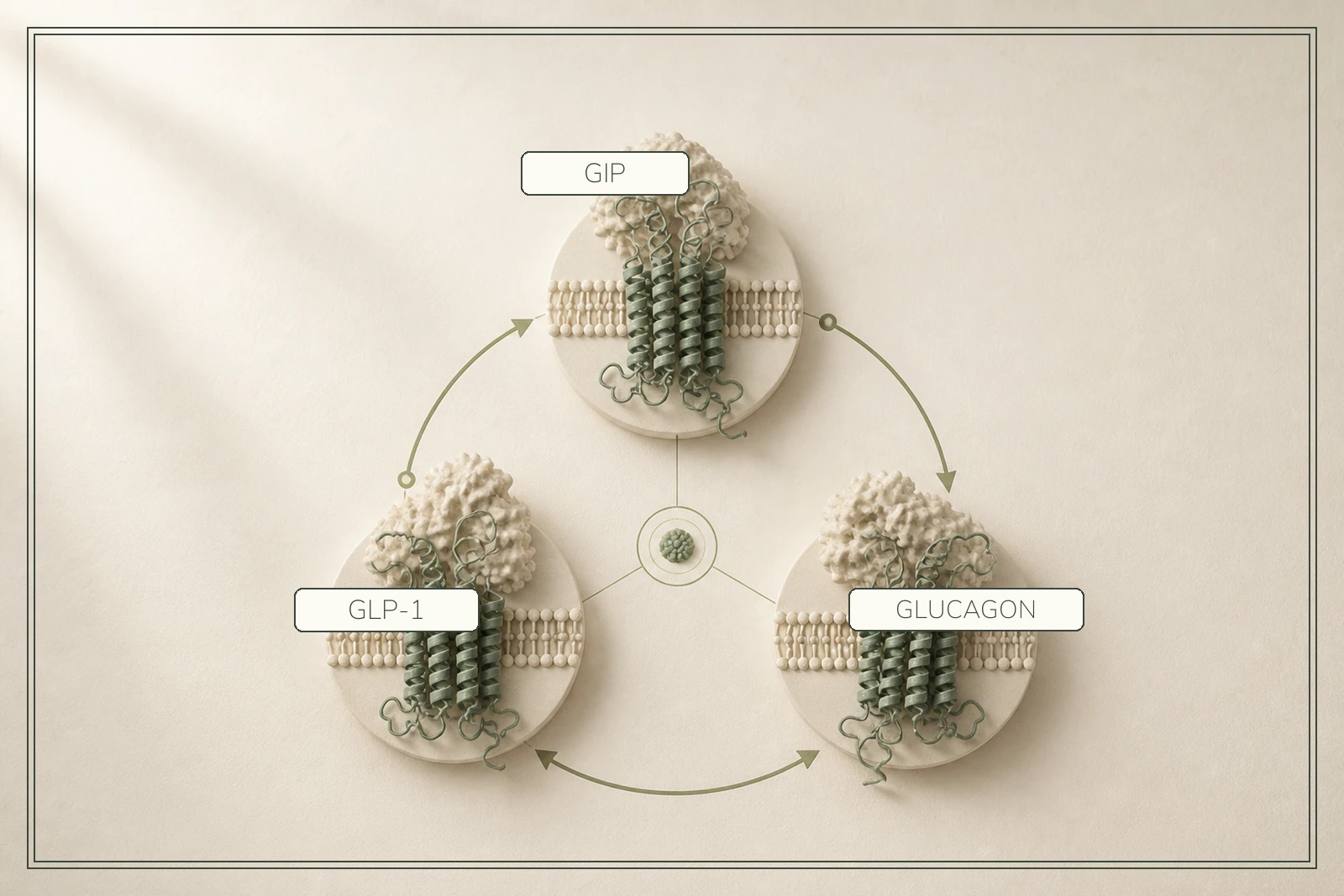
Three receptor targets, all beginning with G: the GIP receptor, the GLP-1 receptor, and the glucagon receptor. Retatrutide is an agonist at all three, meaning it activates each of them, and no earlier compound in this class did all three at once.
The shorthand is community usage rather than official terminology. You will not find it in the trial literature, where the compound is described as a triple-hormone-receptor agonist or by its development code. It circulates because it is easier to say, and because the number genuinely marks the thing that distinguishes this molecule from its predecessors.
The nickname is also mildly misleading in a way worth correcting, since it is the source of the mixture assumption. "Triple" describes what the molecule binds to, not what the molecule is made of. There are not three components in the vial, and there is no ratio to get right, because a single peptide chain carries all three activities at once by virtue of its sequence. Anyone offering retatrutide as a blend, or advertising the proportions of its parts, has misunderstood the compound or is describing something else.
Who developed retatrutide, and what is LY3437943?
Eli Lilly and Company developed it, and LY3437943 is that company's internal development code for the same molecule. The two names are not two compounds.
Pharmaceutical developers assign a code long before a compound has any other name, because candidates enter preclinical work years before anyone decides whether they will ever need one. The "LY" prefix is Lilly's own convention and the number identifies the specific candidate. This is why the earliest literature on retatrutide refers only to LY3437943, and why searching that code rather than the word "retatrutide" is the faster route to primary sources rather than commentary about them.
"Retatrutide" itself is an international non-proprietary name, assigned through the World Health Organization's INN programme, which exists so that every country can refer to a compound by the same word regardless of who eventually sells it. INNs are built from stems that signal what class a compound belongs to, which is why so many names in this area share endings — the similarity is a naming convention doing its job, not a family resemblance between products.
For a buyer, the practical value of knowing all this is small but real. A listing that cannot name the developer, the code, or the trial programme is written by someone who has not read the source material, and that is a reasonable thing to weigh before trusting their documentation.

How does that differ from semaglutide and tirzepatide?
By counting receptors, and more importantly by what the third one adds.
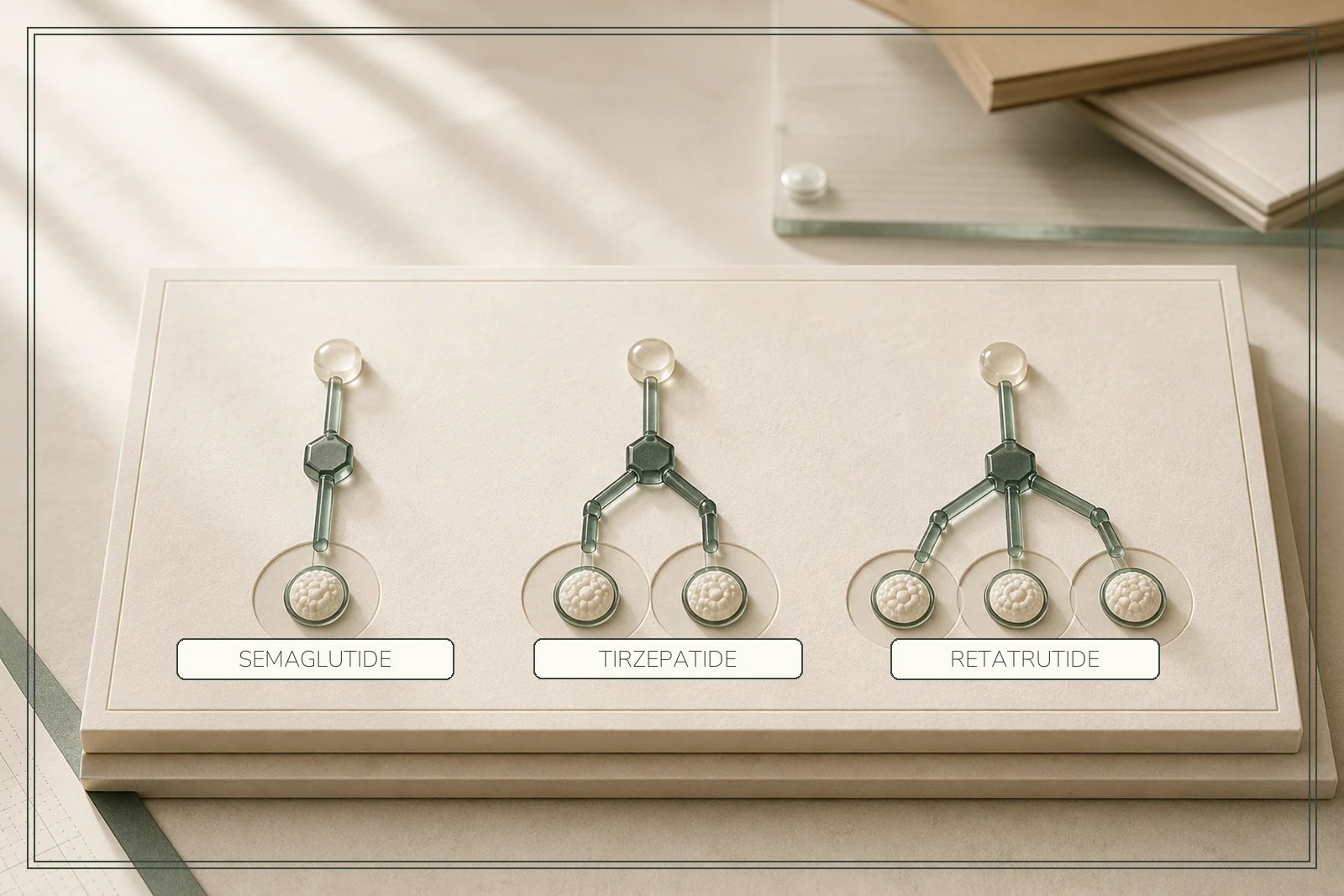
Retatrutide binds three receptors: GLP-1, GIP and glucagon. Semaglutide reaches only the first of those; tirzepatide reaches the first two. Described that way it sounds like a simple progression, but the third addition is qualitatively different from the second.
GLP-1 and GIP receptor activity works largely through appetite and glycaemic pathways, reducing intake. Glucagon receptor agonism operates on the other side of the equation: it is associated with increased energy expenditure and with hepatic fat metabolism. So retatrutide is not simply a stronger version of what came before. It engages a different mechanism alongside the familiar ones, which is why it is studied for hepatic outcomes as well as body weight.
One caveat belongs here rather than in a footnote. The receptor map does not tell us how much of the result each of the three receptors contributes. Retatrutide was tested whole and never as its parts, so that split remains unmeasured: the mechanism is documented, the arithmetic behind it is not.
Why does retatrutide have no brand name?
Because brand names are granted at marketing authorisation, and retatrutide does not have one.
Semaglutide and tirzepatide carry brand names because regulators assessed them and approved them for specific indications. Those names belong to authorised products. Retatrutide is still in phase 3 and has not been assessed for authorisation anywhere, so no brand name exists for it. The compound has only its international non-proprietary name and its development code.
This has a practical consequence worth carrying into any purchase. If material is offered under an invented brand name, that name was not granted by any regulator, because no regulator has granted one. A brand name on an unapproved compound is not a mark of legitimacy. It is closer to the opposite, and it is one of the easier signals to check.
The same reasoning applies to packaging that imitates an authorised product — printed cartons, patient-facing leaflets, dosing panels. None of that can have originated with a regulator, because no regulator has assessed the compound. What it signals is a supplier trying to borrow the appearance of authorisation, and the effort spent on the impression is effort not spent on the analysis.

Why does the same compound appear under different names?
Because three separate naming systems are operating at once, and a fourth has grown up alongside them.
The development code, LY3437943, belongs to the developer. The international non-proprietary name, retatrutide, belongs to the WHO system and is the name the trial literature settled on. A brand name would belong to an approved product, and as the previous section explains, none exists. Community shorthand — "Triple G", or simply "reta" — belongs to nobody and appears nowhere official, which is exactly why it is the version most likely to turn up on a listing written by somebody who has never read a paper.
There is a fifth variation that is easier to miss because it looks like a typo rather than a distinction. Peptides are frequently supplied as salts, and retatrutide acetate is not a different compound from retatrutide but it is a different substance to weigh: the salt and counter-ion contribute mass that the peptide itself does not. A certificate of analysis that names the form removes the ambiguity. One that says only "retatrutide" has left a quantity question open.
The general point sits underneath all of them. A name on a label is a claim about contents, never evidence of them, and the check that closes the gap is whether the analytical document names the same compound in the same form as the listing that sold it — one item on the longer list set out in how to check a certificate of analysis is genuine.
What does knowing the mechanism not tell you?
Whether the vial in front of you contains it.
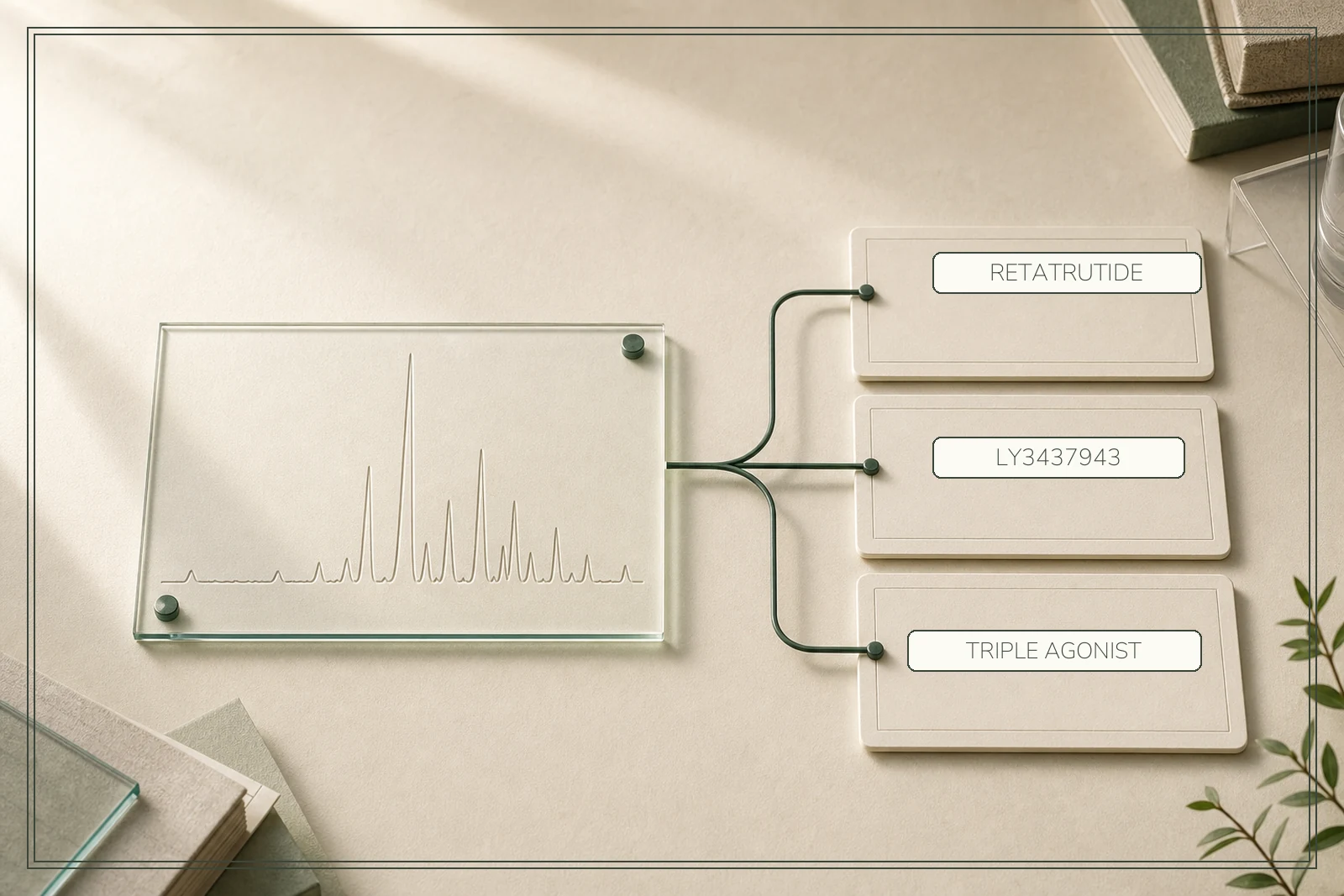
Mechanism is a property of the compound. Contents are a property of the material, and no amount of understanding the first establishes anything about the second. A supplier can describe triple agonism accurately and still ship the wrong molecule, which is precisely why identity confirmation by mass spectrometry exists as a separate test from purity.
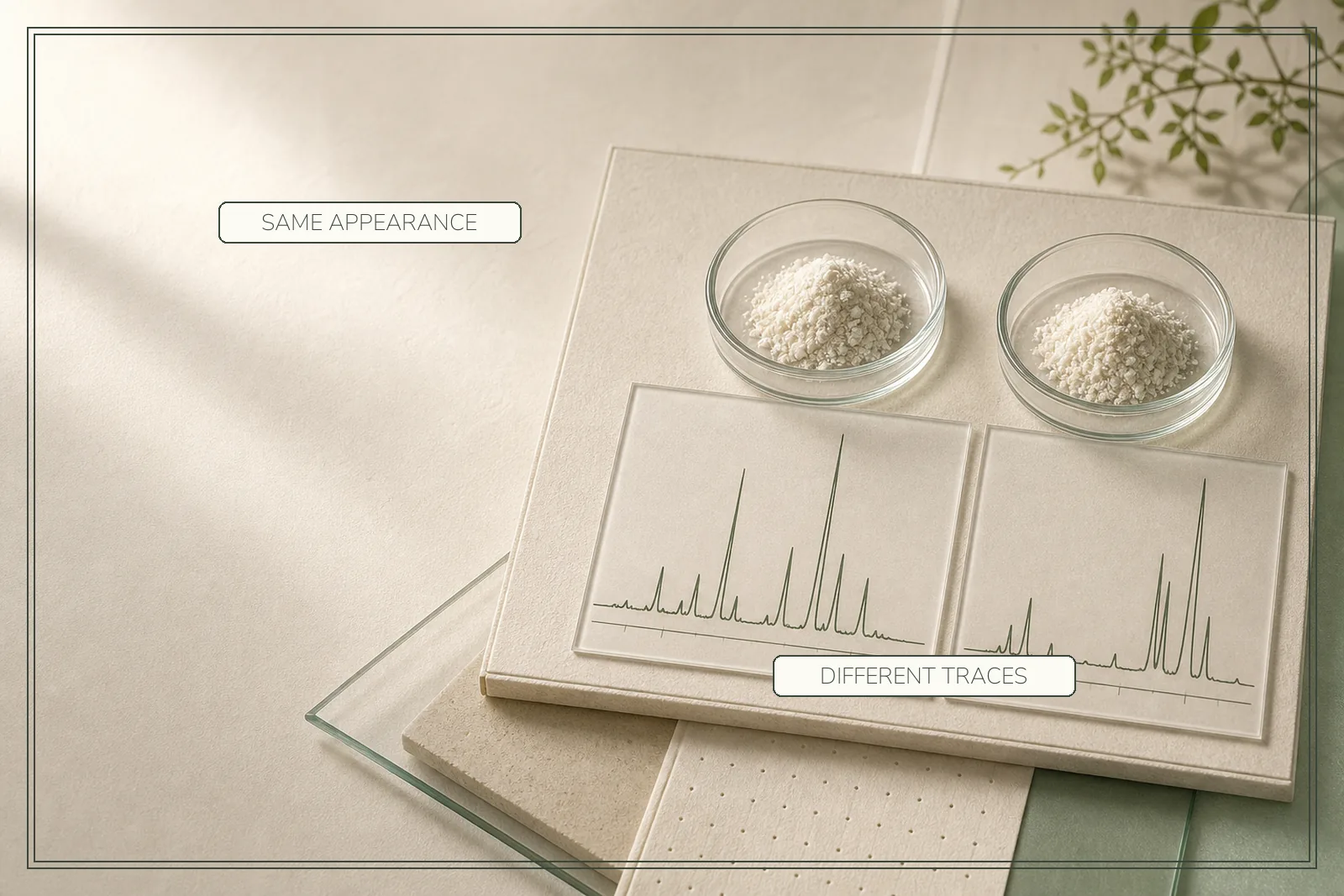
Purity asks how much of the sample is one substance. Identity asks whether that substance is the peptide named on the label. A sample can score extremely well on the first while failing the second entirely.
This is the single most common gap in research-market documentation, and it is not usually deliberate. Purity testing is cheaper and faster, it produces a satisfying number, and a supplier who has paid for it reasonably feels they have paid for testing. But a chromatogram showing one clean dominant peak is a statement about how many things are present, and it stays silent on what they are. The two tests answer questions that only sound like the same question.
Confirming what you actually have
Because identity cannot be judged by appearance, it has to be documented. We publish per-lot certificates of analysis with lot numbers matching the vial, HPLC chromatograms rather than summary percentages, and mass-spectrometry identity confirmation for each lot.
You can see what ships in our retatrutide 20mg vial, with current lot documentation linked from the listing. Our certificates name the compound and the form supplied rather than leaving either to inference, and they carry the lot number printed on the vial you receive so the document can be matched to the material rather than to the product line. If you are still working out what to look for, the supplier checklist covers it in full, and how retatrutide compares to semaglutide and tirzepatide goes further into the mechanism.
What we would ask you not to do is treat any of this as a reason to skip the check. The whole argument of this page is that the name, the mechanism and the marketing are all things a supplier can get right on a web page without ever having tested a vial. That applies to our web page too. The documents are published so they can be read, not so they can be pointed at. Supplied for laboratory research use only.
For research use only — not for human consumption. Nothing here is medical advice.