
Lab Team
The real distinction is not how many receptors each compound hits. It is that two are licensed medicines and one is an investigational compound in phase 3.
Comparisons between these three compounds almost always run on receptor count and percentage figures, and both of those are the wrong place to start. The distinction that actually separates them is regulatory: semaglutide and tirzepatide are licensed medicines assessed and approved by regulators, and retatrutide is an investigational compound whose phase 3 programme is still running. Everything else follows from that.

Why does regulatory status matter more than receptor count?
Because it determines what is known, who checked it, and what happens when something goes wrong.
A licensed medicine has been through phase 3 trials at scale, assessed by a regulator, manufactured under inspected conditions and released batch by batch. It carries a brand name, an approved indication, a summary of product characteristics and ongoing post-marketing surveillance that continues to collect safety data after approval. A prescriber stands between the patient and the product.
An investigational compound has none of that. Its phase 3 data is not yet complete, no regulator has assessed it, and no post-marketing surveillance system exists because there is no marketed product. These are not two grades of the same category. They are different categories, and a comparison that omits this is comparing the wrong things.
The asymmetry is clearest in what happens when something goes wrong. A licensed medicine sits inside machinery built for that eventuality: adverse events are reportable to a regulator, defective batches can be recalled through a traceable supply chain, and a named manufacturer carries liability for what it released. None of that machinery exists on the other side of the line. There is no recall route for a research reagent, no authority collecting reports about it, and no assessment to appeal to.

How do the three compounds differ mechanically?
By which receptors they activate, in a clear progression.
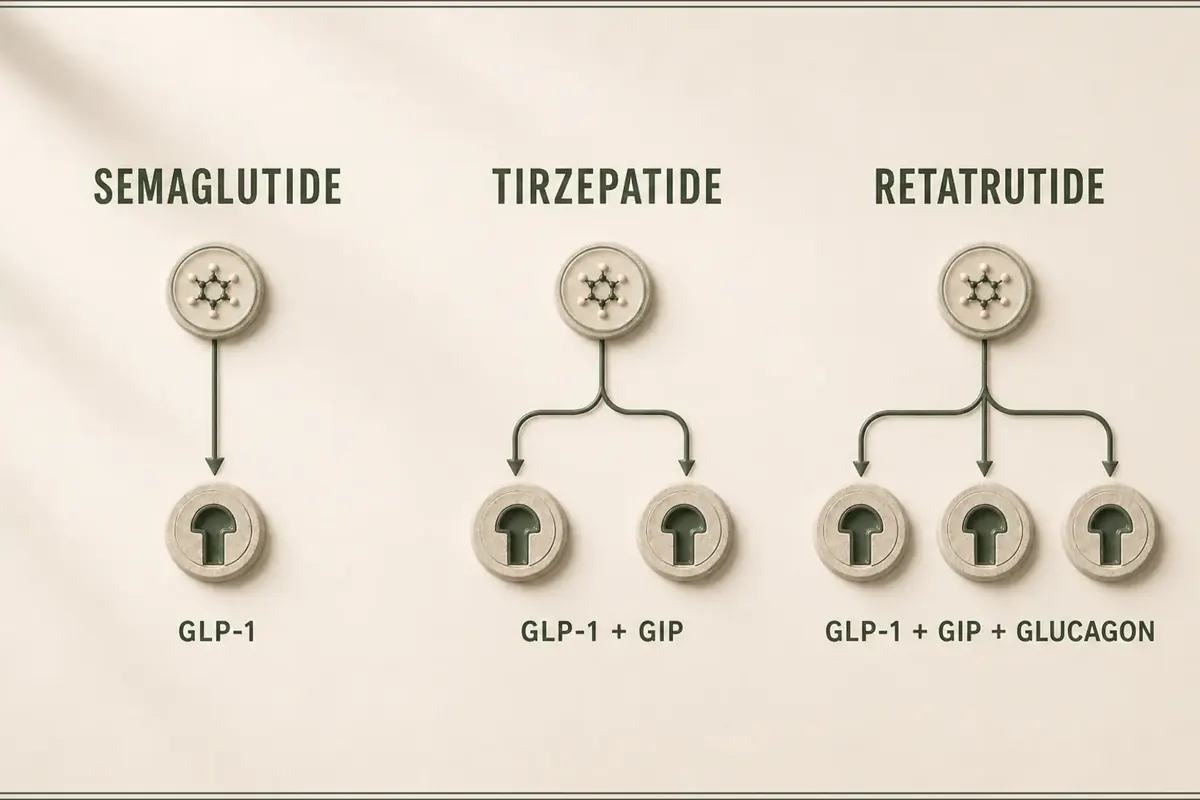
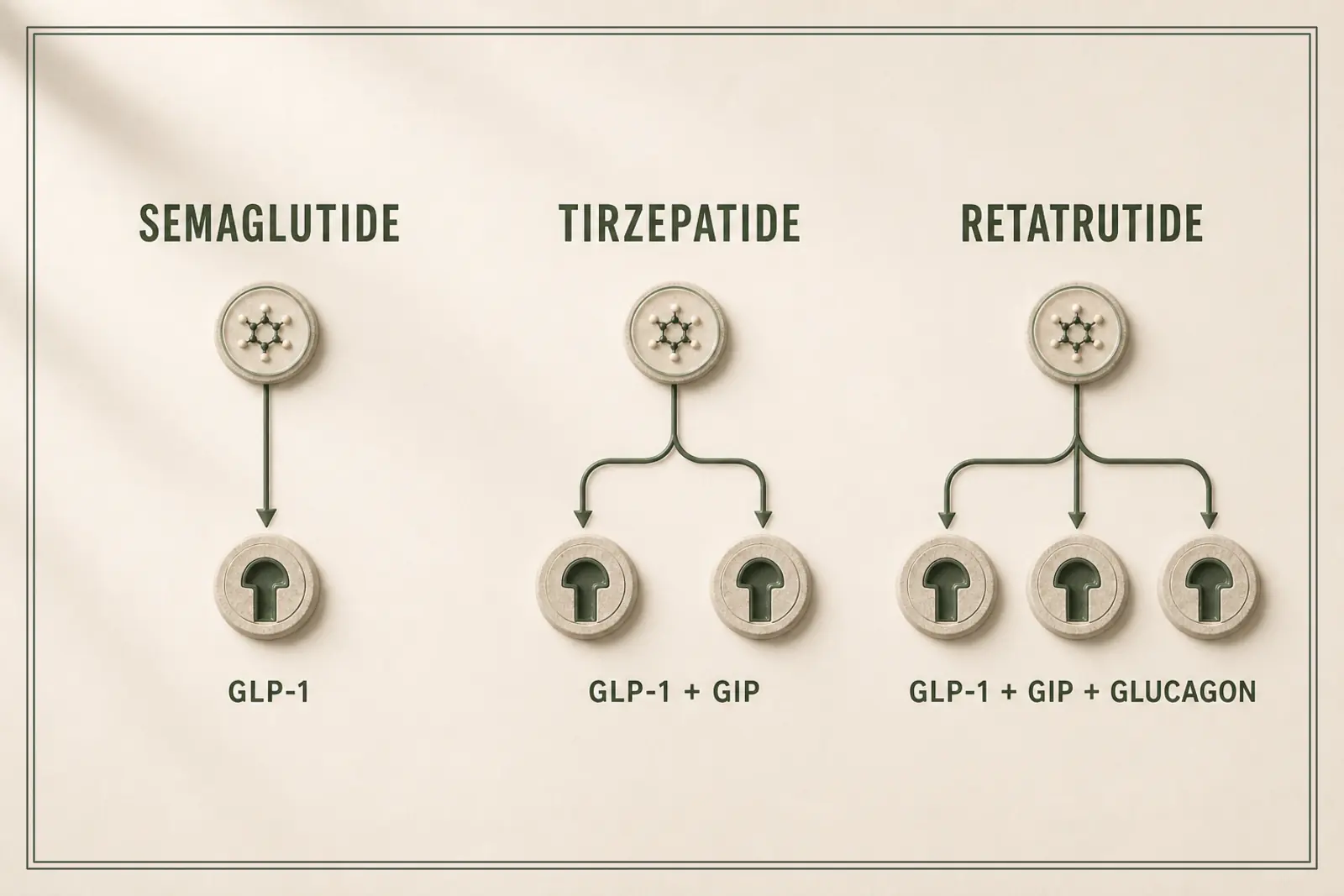
Semaglutide acts at the GLP-1 receptor alone. Tirzepatide acts at the GLP-1 and GIP receptors. Retatrutide acts at those two and adds the glucagon receptor. The first two mechanisms operate largely through appetite and glycaemic pathways. The third is associated with energy expenditure and hepatic fat metabolism, which is a different lever rather than a larger version of the same one.
That progression is real and well documented. What it does not establish is a ranking, which brings us to the figures.
It is worth being precise about why more receptors does not automatically mean more effect. Each additional target adds an activity, and activities interact rather than stacking. A third mechanism can amplify the first two, or it can introduce effects that constrain how the compound behaves overall — and which of those happens is an empirical question answered by trials, not by counting. The progression describes what the molecules do. It does not predict where any of them finishes.
Can the trial percentages be compared directly?
No, and this is the most common error in the entire comparison.
The headline figures for these three compounds come from separate trials with different participant populations, different entry criteria, different durations, different escalation protocols and different accompanying lifestyle interventions. Lining the percentages up in a table produces something that looks like evidence of superiority and is not.
Establishing that one compound outperforms another requires a head-to-head trial in which participants are randomised between them under identical conditions. Where such trials have not been run, the honest statement is that the relative effect is not established, however tempting the arithmetic looks. Cross-trial comparison is a well-recognised methodological error, not a shortcut around missing data.
The instability runs deeper than the gap between trials, which is why the tidy tables are more misleading than they look. Even for a single compound in a single study, the headline figure depends on choices made in the analysis: whether the number describes everyone randomised or only those who completed, and how participants who left early were accounted for. Those choices are legitimate and they are disclosed in the paper. They also mean two different, correct figures can circulate for the same trial — and a comparison table quoting one of them alongside a differently-derived figure from elsewhere has stacked two mismatches into one number.

Has anyone run a head-to-head trial?
No. No published trial has randomised participants between retatrutide and either semaglutide or tirzepatide under identical conditions, which is the only design that answers a comparative question directly.
What exists instead is indirect comparison. Network meta-analyses and ranking tables estimate relative effect by linking separate trials through a shared comparator — usually placebo — and calculating what the difference between them would have been. This is a legitimate statistical method with a real literature behind it, and it is not the same thing as a measurement.
The weakness sits in the assumption the method requires: that the trials being linked are similar enough to be linked at all. Comparable populations, comparable durations, comparable background care. Where they are not, the mismatch is carried silently into the estimate, and the output still arrives as a single tidy number with the three compounds in order. Nothing in the presentation flags how much assumption is inside it.
The practical consequence is narrow. A table ranking these three is an estimate built on a premise, and it may well turn out to be correct. It is not evidence of the same kind as a randomised head-to-head, and that distinction vanishes the moment the number is quoted without its method attached. Retatrutide's phase 3 programme will add a great deal when it reports, but a trial against placebo still answers a placebo question. Only a head-to-head answers this one.

How does availability differ between the three?
Two of them can be obtained through a prescriber. The third cannot be obtained that way at all, anywhere.
Semaglutide and tirzepatide hold marketing authorisations for specific indications. A clinician can prescribe them, a pharmacy dispenses them, and what arrives has been manufactured under inspected conditions and released batch by batch. Retatrutide holds no authorisation in any territory, so no prescription route exists for it. Its only commercial existence is as a research reagent.
The difference people tend to miss is that this is not a difference in difficulty. It is a difference in what actually arrives. The licensed route hands you a product that a chain of other parties has already verified. The research route hands you a product that nobody has verified except the person selling it, and the entire burden of establishing what is in the vial moves onto you and onto whatever documentation the supplier chose to publish.
That is also why these are not interchangeable routes to a similar outcome, and nothing on this page should be read as suggesting they are. The regulatory gap described at the top of this article is the whole of the difference, and it does not close because one option is easier to reach than another. What obtaining retatrutide as a research material actually involves is set out in the availability question in full.

What should someone do with this comparison?
Understand the categories, and stop there.
If you are researching retatrutide, the useful conclusion is that it engages a mechanism the licensed compounds do not, and that its evidence base is at an earlier stage than theirs. Both halves of that sentence matter. The first is why it is interesting. The second is why it is not a substitute for anything.
Decisions about licensed medicines belong with the prescriber who issued them, and nothing here is guidance to alter such a decision. Retatrutide is supplied for laboratory research use only, and that is the only context in which we discuss it.
Holding those two halves together is harder than it sounds, because most writing on this topic collapses into one or the other. Accounts that lead with the third receptor treat an earlier evidence base as a detail. Accounts that lead with the missing authorisation treat a genuinely novel mechanism as though it were nothing. The compound is interesting and the evidence is incomplete, and both of those remain true at the same time.

Sourcing a compound at this stage
Because retatrutide sits outside the licensed supply chain, nobody has verified any given vial on your behalf. That verification burden transfers entirely to the supplier's documentation.
We publish per-lot certificates of analysis with matching lot numbers, HPLC chromatograms rather than summary figures, and mass-spectrometry identity confirmation. You can read those documents on the retatrutide 20mg listing.
None of that substitutes for what a marketing authorisation provides, and we would not present it that way. A batch-released licensed medicine carries an inspected manufacturing chain and a regulator's assessment behind it; a certificate of analysis carries one laboratory's measurement of one lot. The second is considerably less than the first. It is also the most that exists on this side of the line, and the meaningful comparison is not against a licensed product — it is against the research suppliers who publish nothing at all. For the mechanism in more depth see what retatrutide actually is, and for what phase 2 does and does not show see the safety data.
For research use only — not for human consumption. Nothing here is medical advice.